There’s a point where building a deck stops being about strategies and starts being about your bank account. One “must-have” staple becomes ten, and suddenly your commander deck costs more than a weekend trip.
That’s why proxies exist.
Magic the Gathering proxy cards let you play the game you love, test powerful cards, and try new ideas without risking your real cards or chasing expensive cards in every booster pack. And if you print them well, your table experience stays clean: clear text, solid color, consistent thickness, and a shuffle that feels normal.
This page is built to answer the questions people actually search:
- What are mtg proxy cards?
- Are gathering proxies allowed in sanctioned tournaments or official tournaments?
- How do I create and print an entire deck from a deck list?
- What quality specs matter (and which ones don’t)?
Choose your path (the 10-second version)
1) I want to order proxy cards (fast)
Upload your deck list, pick options, and check out. We handle the process, shipping, and tracking.
2) I want to print at home
We’ll give you the details: sizing, bleed, DPI, export settings, and a print-ready pdf layout per sheet.
3) I want to know what’s allowed
If you’re playing casual play with friends, proxies are usually fine. If it’s a sanctioned event, the rules are different.
What are proxy cards in MTG?
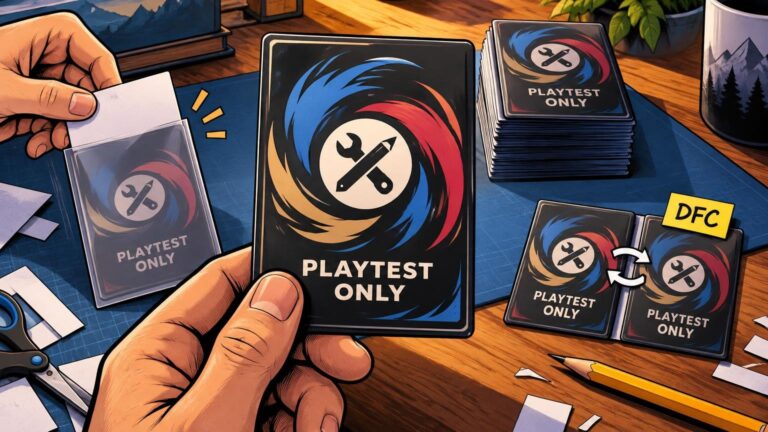
Proxy cards (also called mtg proxy cards or gathering proxy cards) are stand-ins for Magic cards you don’t own, don’t want to risk damaging, or want to test before you buy.
People use magic the gathering proxies for a few common reasons:
- Access: the cards exist, but the cost is out of reach.
- Testing: you want to test a deck idea before spending real money.
- Protection: you own the card, but want to keep authentic magic cards in a binder while you play.
- Convenience: you want more cards ready to go, without hunting down every one card you’re missing.
Order an entire deck from a deck list
This is the part most website homepages mess up. They talk about quality but make ordering feel like work.
Here’s the clean flow your users want:
- Upload your deck list (or paste it)
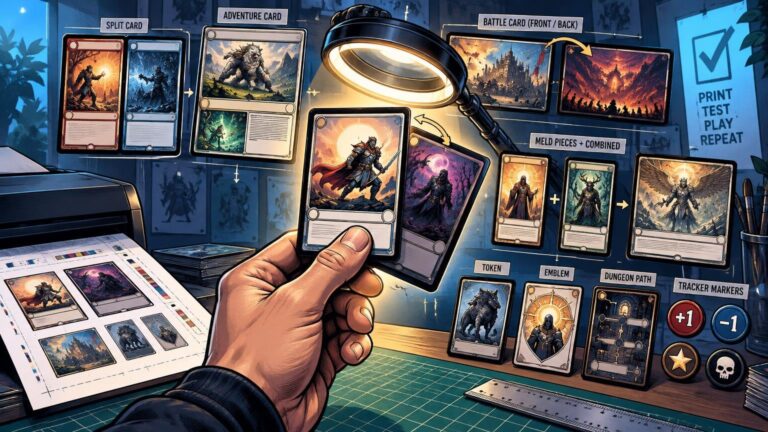
- Confirm counts (including tokens if needed)
- Choose print options (finish, backs, etc.)
- Checkout and get an order confirmation
- We print, pack, and ship with tracking
That’s it. No confusing steps. No guessing. And you don’t have to wait weeks just to find out something was missing.
MTG proxy card specs that matter
You can’t “wish” quality into existence. It comes from specs.
Same size (so your deck feels right)
Your mtg proxy cards should be the same size as standard Magic: The Gathering gathering cards so they fit your sleeve and shuffle cleanly. If sizing is off, you’ll notice immediately—especially when you stack a deck or slide it into a deck box.
Image clarity (readable beats fancy)
Good images matter more than shiny marketing. You want:
- crisp rules text
- clean mana symbols
- solid blacks (no muddy shadows)
- stable gradients (no banding)
If your source art is low-res, your print will look soft. Simple as that.
Paper and cardstock (feel + durability)
If you want proxies that don’t scream “home printer,” the paper and cardstock choice is a big deal. Thickness, stiffness, and opacity control the “shuffle feel.” You don’t need perfection. But you do want consistency.
Perfect condition (what that actually means)
“Perfect condition” in printing doesn’t mean “never a flaw.” It means the final cards are:
- cleanly cut
- centered within tolerance
- readable
- consistent enough that no single card stands out in a sleeve
That’s the real goal for play.
Print-ready files: how to avoid the classic mistakes
If you’re printing at home (or building files for pro print), here’s the short checklist:
- Export at a solid resolution
- Include bleed so cuts don’t leave white edges
- Keep important text inside safe margins
- Build a clean layout per sheet
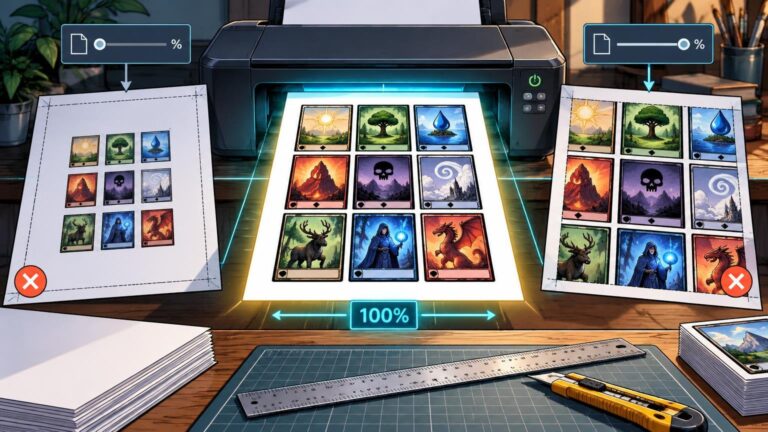
- Save as a pdf when you want consistent print scaling
If you’re stuck, it’s usually one of these:
- the page size doesn’t match your printer setting
- your scaling is set to “fit” instead of 100%
- the bleed got cropped off in export
If you’re still stuck, you’re not alone. This is the most common failure point.
Custom art, uploads, and compatibility
A lot of people want proxies that look “close to real,” and a lot of people want something totally custom. Both are valid.
- Want classic frames and readable layouts? Great.
- Want custom art? Also great.
- Want a proxy that’s still compatible with sleeves, shuffling, and table readability? That’s the standard either way.
Just keep it simple: readable names, readable costs, readable text. That’s what matters mid-game.
Price, value, and what you’re actually paying for
Everyone cares about price. But what you really want is value.
A cheap proxy that looks bad, cuts wrong, or arrives bent costs you twice: once in dollars, and again when you have to replace it.
So here’s the honest breakdown:
- You’re paying for consistent printing
- You’re paying for materials (stock + finish)
- You’re paying for cutting accuracy
- You’re paying for reliable fulfillment and service
If you’re ordering in quantity, you also want bulk pricing that doesn’t punish you for printing a cube or multiple decks.
Shipping that doesn’t ruin the experience
If your proxies arrive curled, scuffed, or poorly packed, the quality doesn’t matter.
This is what good shipping looks like:
- protective packaging
- clear turnaround expectations
- fast shipping options when you need them
- full tracking from label to delivery
Your customers shouldn’t have to guess where their order is.
Why people use gathering proxies (the real reason)
Most people aren’t trying to “cheat.” They’re trying to play more.
Proxies help you:
- try new archetypes without buying everything first
- build multiple decks for a group night
- keep real cards safe at home
- explore the entire mtg world without turning the hobby into a second job
And honestly? It makes the hobby more fun.
FAQ: quick answers people actually search
Can I use MTG proxy cards in Commander?
Usually yes for casual play, as long as your group agrees.
Are proxy cards legal in sanctioned tournaments?
No. Sanctioned play requires authentic cards, with limited judge-issued exceptions.
Do proxies need to be the same size?
If you want a clean shuffle and no marked cards in sleeves, yes—same size is the baseline.
Can I upload my own images?
You can upload custom art and layouts if your service supports it. Keep readability first.
What’s the best file format?
For print layouts, a PDF is the safest. For single-card work, high-quality exports can work too.
How many cards should I start with?
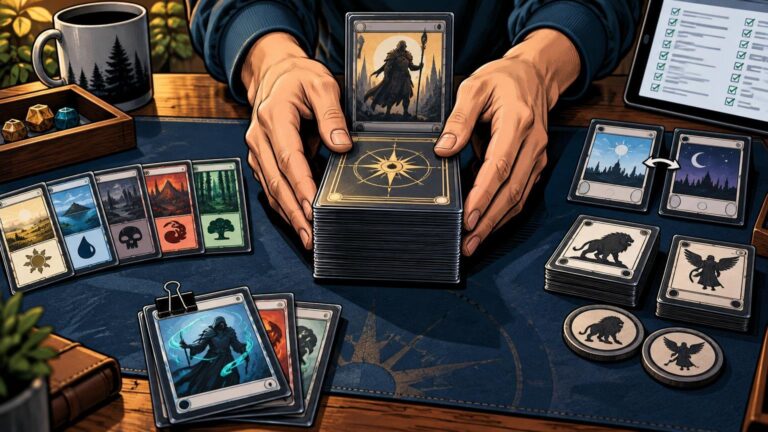
If you’re unsure, start with one deck. Then scale up to an entire deck, a cube, or multiple lists.
Will proxies look “amazing” like real cards?
They can look very close, but the goal is playability and consistency—not pretending they’re authentic.
Closing thought + CTA
If you’re here, you probably want one of two things:
- You want to print a deck fast and clean, without babysitting file settings.
- Or you want guidance so your next print run doesn’t come out blurry, miscut, or disappointing.
Either way, this is meant to be a good choice you can feel good about.
Ready to start? Upload a deck list, pick your options, and check out. Or grab the print settings guide if you’re doing it yourself.